
As a certified Master Textile Cleaner, I get lots of questions about different carpet cleaning techniques.
Most people have heard of “steam cleaning”. But professional carpet cleaners actually have a variety of techniques. Each comes with its own advantages and disadvantages. In this post, we will explore the top 5 professional carpet cleaning techniques.
You’ll probably never need to use them yourself. But this post will help you to understand your cleaner’s recommendations. You’ll also find out exactly what to expect from each method.
After all, educated consumers are always happier consumers. They save money and end up with the results they are looking for. Keep reading to become one of them.
Why Are There So Many Carpet Cleaning Techniques?
Textiles come in all shapes and sizes.
Any decent professional carpet cleaning company can clean carpets, rugs, upholstery, other household textiles. Some—like ProTech Carpet Care—can even go beyond this to clean tile, leather, or your air ducts! Each material presents unique problems.
Therefore, each requires unique solutions. The five most common professional carpet cleaning techniques are:
- Hot Water Extraction (“Steam Cleaning”)
- Absorbent Compound (“Dry Cleaning”)
- Bonnet Cleaning
- Carpet Shampooing
- Encapsulation
The following are just a few of the most commonly used techniques in a true carpet cleaning expert’s bag of tricks.
Hot Water Extraction
Otherwise known as steam cleaning, this is easily the most common professional carpet cleaning technique. Steam cleaning uses hot water at high pressure to penetrate into carpet fibers, breaking down the dirt and bacteria stored deep within.
The hot water is then extracted via vacuum. This is where the technical name “hot water extraction” comes from.
The cleaning process begins with the application of a cleaning agent onto the target area. The cleaning agent is then spread via brush, break up dirt. The actual hot water extraction only comes into play once the cleaning agent is given time to do its work.
Steam cleaning can take an hour to clean an average home, and twice that for carpet to dry. Offices and other commercial properties can take much longer. Performing commercial cleaning jobs later in the day is a common practice as the it can allow time for carpets to dry overnight.
In some cases though, a few hours of damp carpets simply isn’t an option.
Absorbent Compound
Absorbent compound cleaning is more commonly known as “dry carpet cleaning”. Dry cleaning uses an absorbent compound that binds to dirt and other substances in your carpet.
Most of the time, a mechanical brush is used to distribute absorbent compounds and disrupt dirty fibers. The compound is given time to separate dirt from the carpet fibers. Then, it is vacuumed up with a professional-strength dry vacuum.
This technique is best for those who need a deep clean but want to avoid wet carpets altogether.
Bonnet Cleaning
Unlike the previous carpet cleaning methods, bonnet cleaning mainly focuses on the carpet’s surface.
“Bonnet machines” are equipped with a spinning pad soaked in cleaning solution. They essentially polish the carpet’s surface, removing dirt and grime.
Bonnet cleaning is common in hotels and other commercial businesses in need of a spruce-up. It is one of the fastest professional carpet cleaning techniques. But it can still make a noticeable difference in carpet appearance.
However, bonnet cleaning is more of a quick fix than a long lasting solution. The soil in the lower layers of the carpet eventually rises back to the surface. This means repeat treatment is usually necessary sooner than for deep cleaning methods.
Bonnet cleaning can also leave a chemical residue.
Carpet Shampooing
Carpet shampooing is one of the oldest professional carpet cleaning techniques still used today.
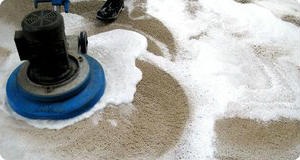
It was the go-to method for heavy-duty carpet cleaning for quite a long time. The process has evolved since its origins but only in terms of the technology used.
Today, carpet shampooing involves a foaming substance that is applied and worked into the carpet with a brush machine. Wet vacuuming is then performed to remove the “shampoo” as well as the dirt attached to it.
The carpet requires some time to dry. Then dry vacuuming removes any leftover residue.
Encapsulation
This technique sounds fancy, and in a sense it is. Encapsulation cleaning uses synthetic foam detergents that are worked into the carpet via brush machine. The foam crystallizes into a powder. As it does so, it encapsulates soil present in the carpet. The powder is then vacuumed up, with the dirt along with it.
Encapsulation is often favored over carpet shampooing because it leaves behind no residue, takes less time to dry, and uses less water.
Still, encapsulation cleaning is not ideal for all circumstances. Most carpet cleaning professionals do not use encapsulation on heavily soiled carpets. It is simply not as effective. In the end, recognizing the best solution requires both education and experience.
As service industry professionals, it is our job to help educate our clients.
But more importantly, it is our duty to have the practical knowledge required to get the job done. Ironically enough, asking your carpet cleaner questions is one of the best ways to decide which carpet cleaner to choose. Technicians that know what they are doing can explain why any given method is best for your particular textile.
If your carpet cleaner can’t explain their recommendations, you might want to take a look at some other options.
If you live in Triad, we’d like to encourage you to call ProTech Carpet Care – The Triads True Carpet Cleaning Experts at (336) 202-2061 for a free estimate. In addition to client education, we provide a 100% satisfaction guarantee—as any true service-industry professional should. If you have a question of comment, leave it below. And please, feel free like and share this post with a friend or two who may need our services.